Used buyer's guideEvery full-frame digital M-mount camera, compared on what matters

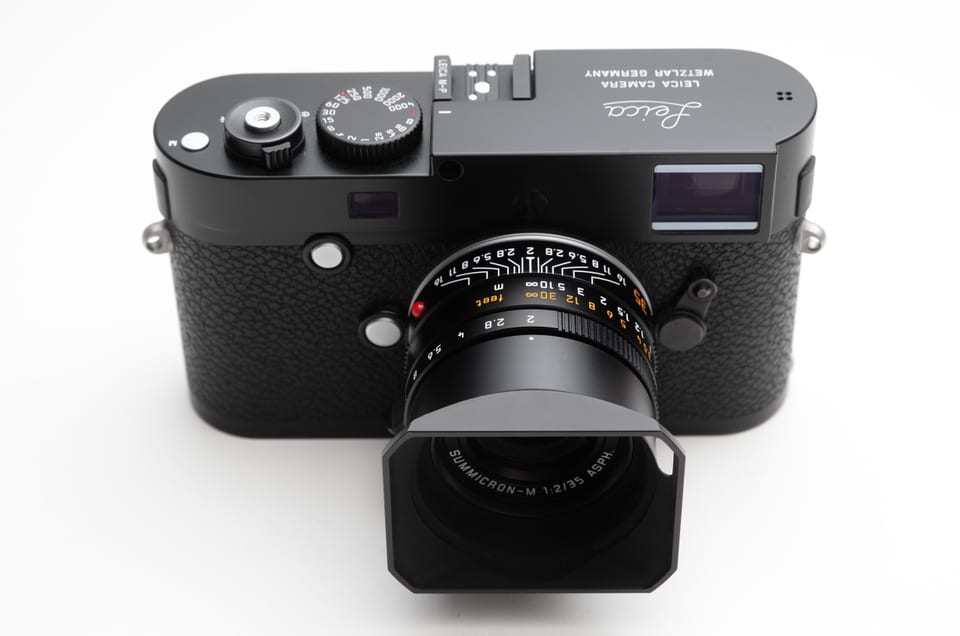
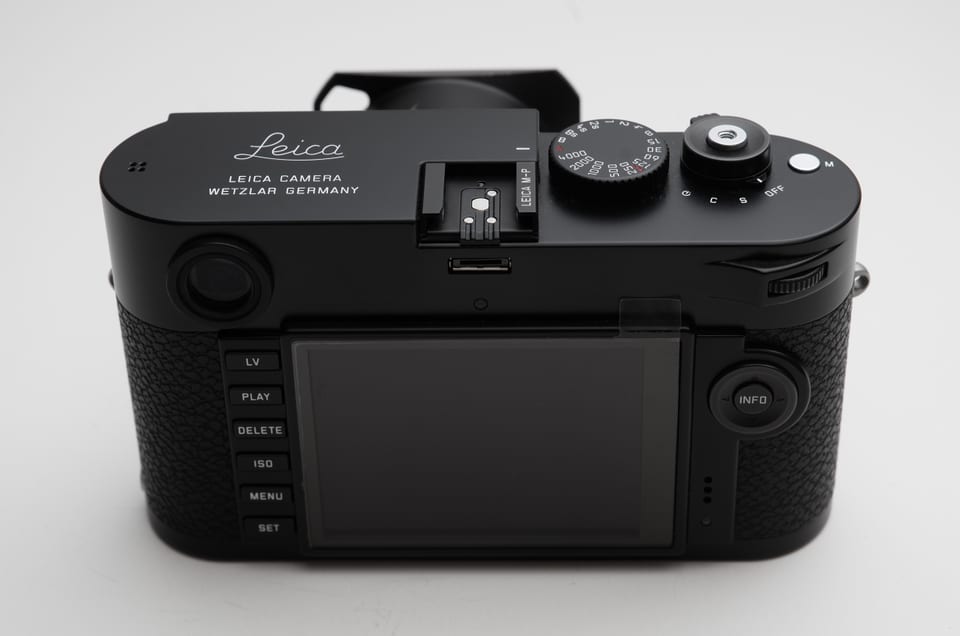
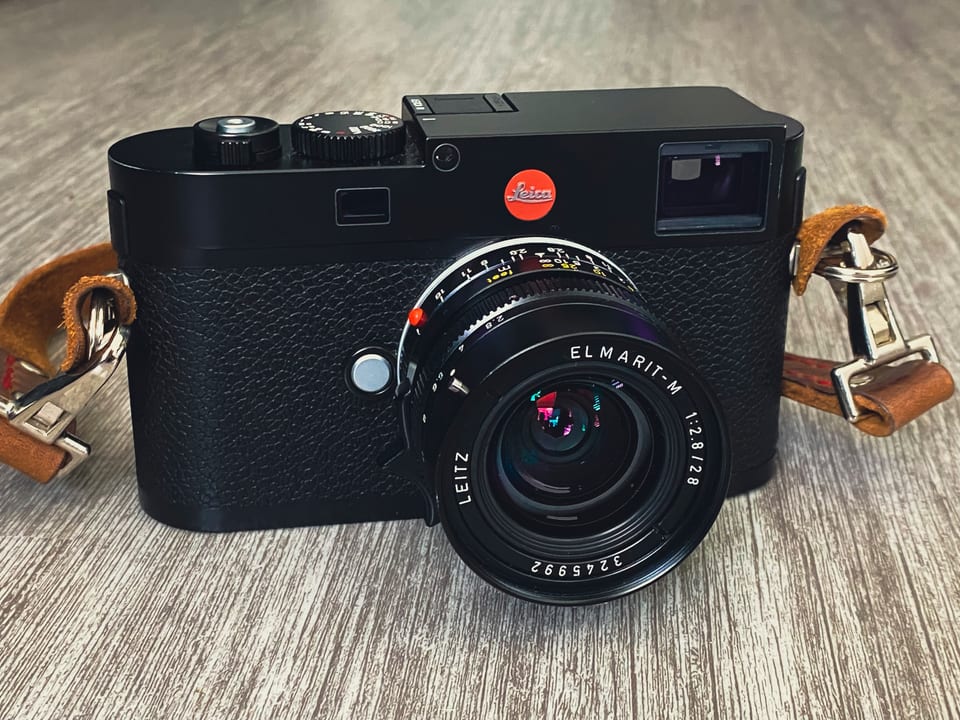
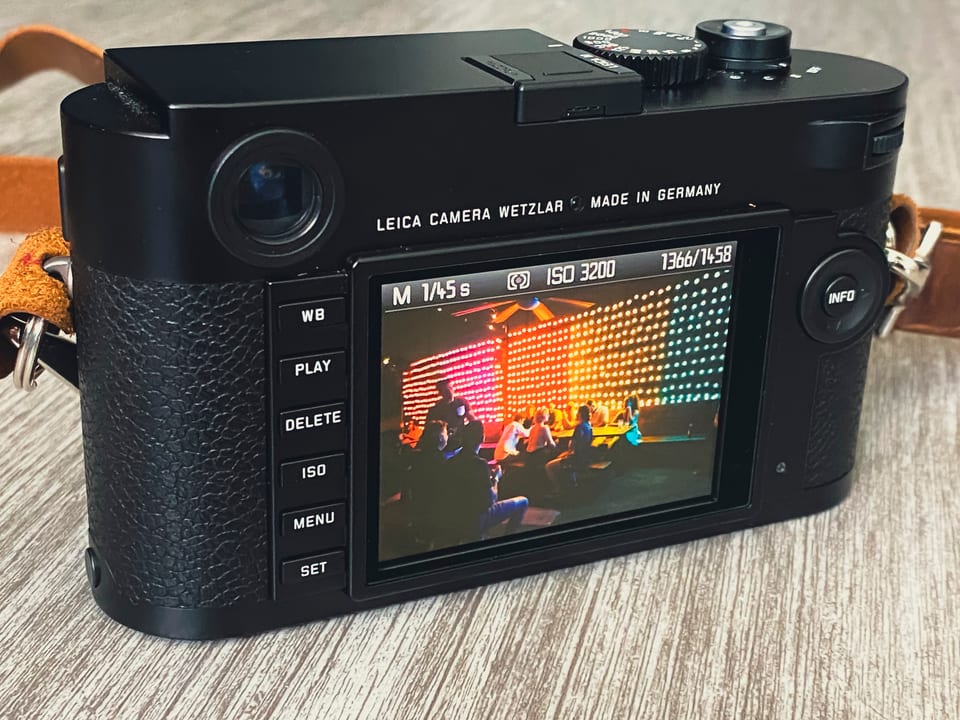
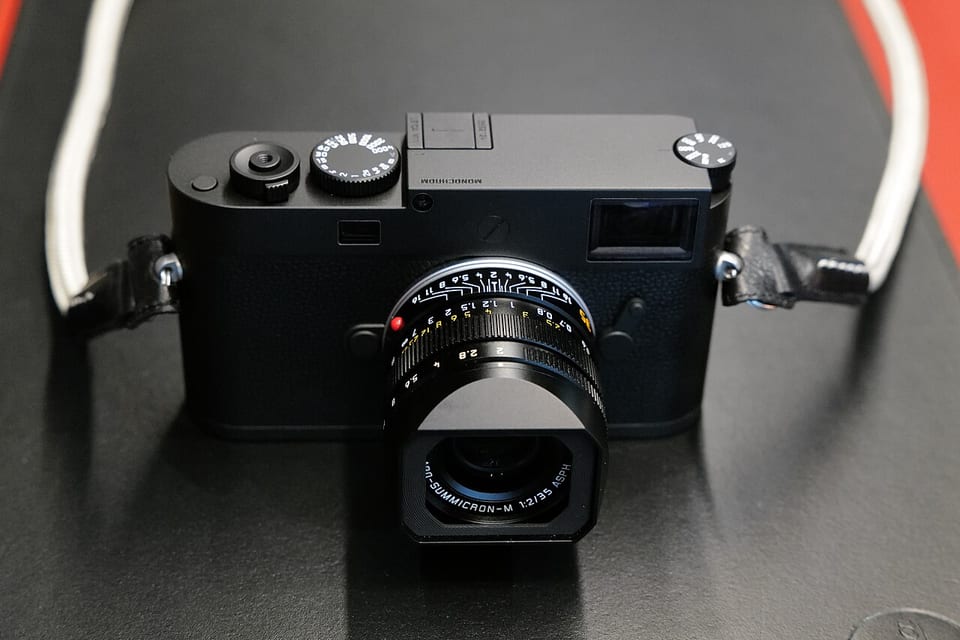
Leica has shipped a dozen-plus full-frame rangefinder bodies since the M9 in 2009, and the names (M-P, Typ 240, M-E, M-D, M10-R, M11-P) hide which ones actually differ. This guide lines them all up, plus the EVF-only M EV1 and the screenless Pixii Max, on the dimensions that decide a used purchase: sensor type and usable ISO, shutter, screen, cards, sealing, close focus, reliability history, size, and what they sell for used at B&H, KEH and Adorama.

Prices observed Sep 2026. Images are Creative Commons photographs credited per camera. Not affiliated with Leica or any retailer.

Decoding the names

Generations

  • M9 generation (2009–2012)Kodak 18 MP CCD. The "CCD look" bodies. No live view, loud shutter, ISO tops out early, and the sensor corrosion saga lives here.
  • Typ 240 generation (2012–2019)First CMOS M: 24 MP CMOSIS sensor, live view, video, a much bigger battery, and a body 5 mm thicker than any other M.
  • M10 generation (2017–2020)Back to film-M thickness, ISO dial on top, three rear buttons, Wi-Fi. The quietest mechanical shutters (-P, -R, Monochrom).
  • M11 generation (2022–present)60 MP BSI sensor, electronic shutter, USB-C, internal storage, no baseplate. Black bodies are aluminum and 110 g lighter than silver.
  • M EV1 (2025–present)The M11 sensor and body with an electronic viewfinder instead of a rangefinder. Focuses as close as the lens allows.
  • Pixii Max (2024–present)A French rangefinder with a 24 MP full-frame sensor, no screen, electronic shutter only, and internal storage. The only non-Leica option.

Suffixes

  • Plain number (M9, M10, M11)the base model of a generation.
  • Typ 240 / 262 / 246 / 220Leica's 2012–2016 internal type numbers, when the base model was just called "M". Typ 240 = the CMOS M, Typ 262 = its stripped version, Typ 246 = the CMOS Monochrom, Typ 220 = the CCD M-E.
  • -Pthe "professional" trim: no red dot, "Leica" script engraved on top, sapphire-glass screen, sometimes a bigger buffer or a quieter shutter. Same sensor as the base model.
  • -Ethe entry model: the previous generation reissued cheaper, usually in anthracite grey with a feature or two removed.
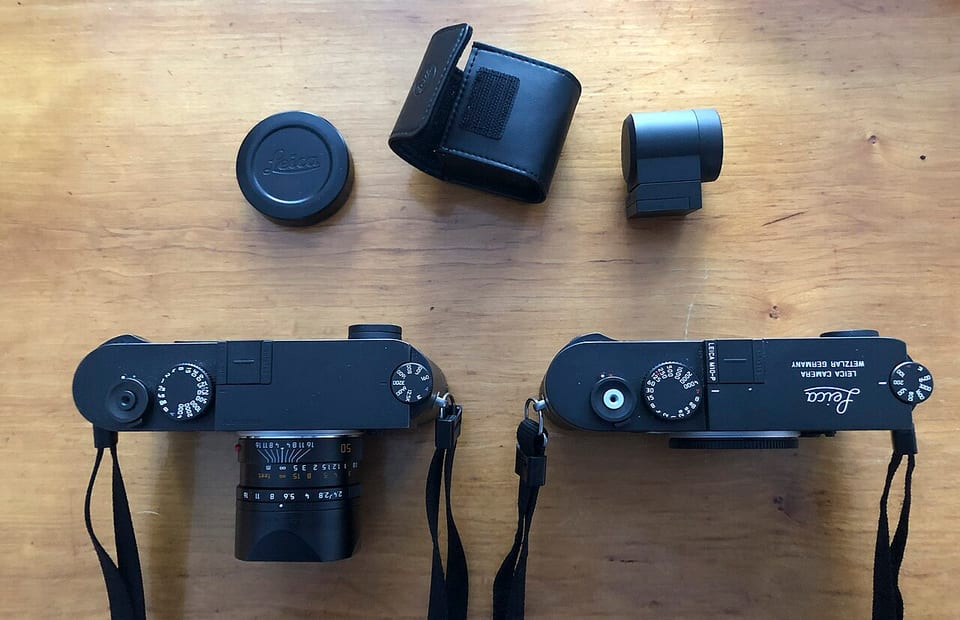
  • -Dno rear screen at all. Exposure via the meter in the finder, ISO on a dial, review images on your phone (M10-D onward) or never (M-D).
  • -R"resolution": the M10 with a 40 MP sensor.
  • Monochromblack-and-white only sensor, no color filter array. About one stop more sensitivity and more detail than the color sibling; no color, ever.
  • EV1electronic viewfinder. The M EV1 drops the rangefinder for an EVF but keeps the M mount and M11 sensor.
21 bodies

M9 generation 2009–2012

Sep 200917 yrs oldM9 (CCD)
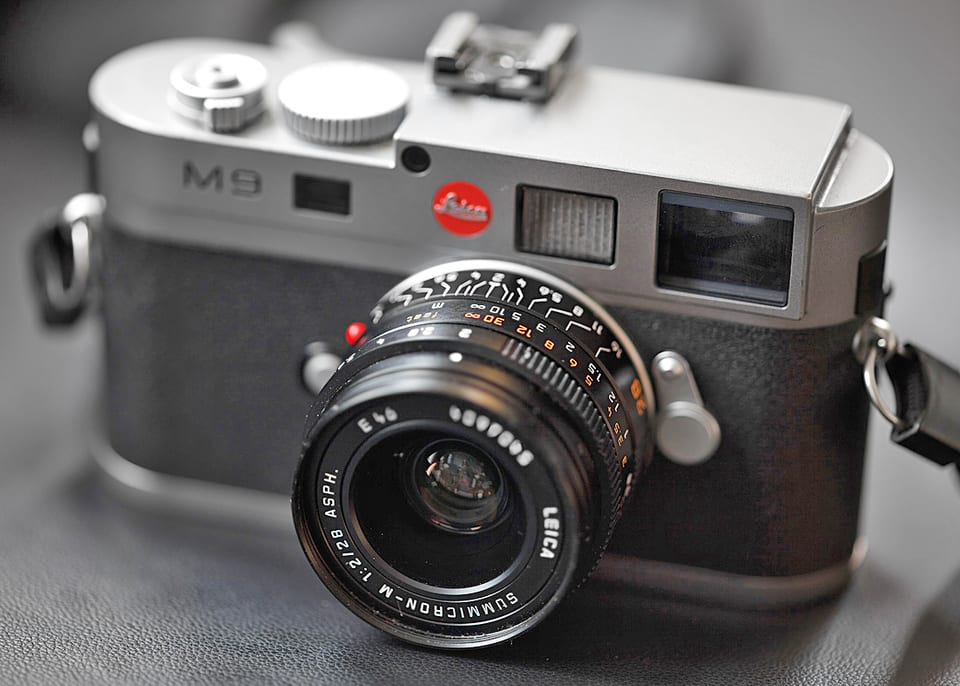
Leica M9 in black, front view with a lens fitted
Denoir, CC BY-SA 3.0
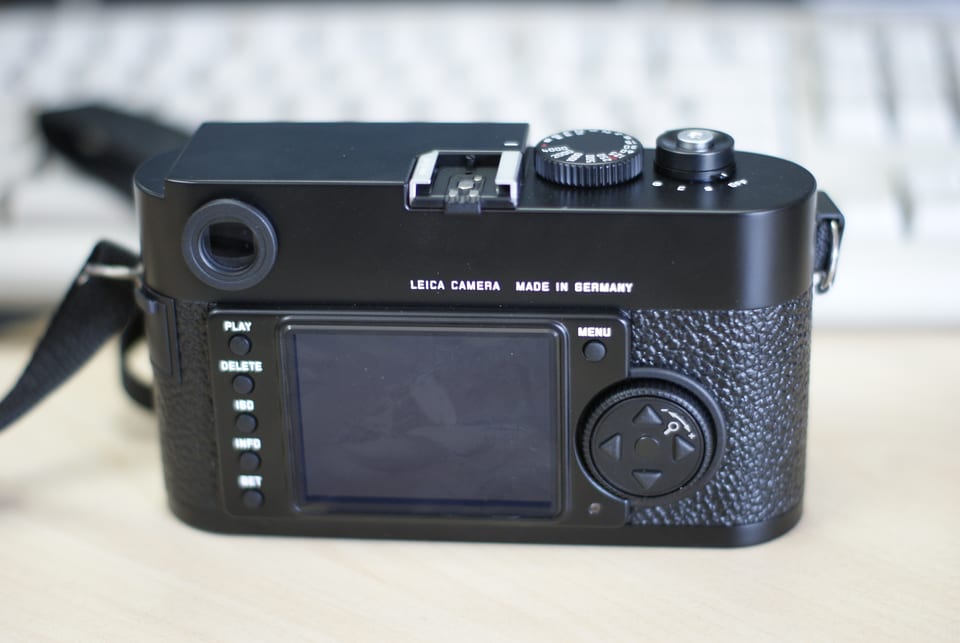
Rear of the Leica M9 showing the 2.5-inch screen and the five-button column
Rear: 2.5" screen, five-button column, thumb wheel. Julien Min GONG, CC BY 2.0

Leica M9

The first full-frame digital M

An 18 MP Kodak CCD in a body the size of a film M. No live view, a tiny 230k-dot screen, and a sensor cover glass that corrodes from the inside. Its files at ISO 160 to 640 are why people still want one.

Sensor18 MP CCDUsable ISO640 clean / 1,250 maxShutter1/4000 mech, 1/180 syncScreen2.5" 230k, no LVCardsSD/SDHC ≤32 GBSealingNoneClose focus0.7 mSize585 g · 37 mm deepReliabilityD

How to recognize it

  • Red dot and "M9" lettering on the front (both absent on the M9-P)
  • Frame-line preview lever beside the mount (absent on the M-E)
  • USB port under a flap (absent on the M-E)
  • Leatherette covering, plain-glass 2.5" screen
  • Steel grey or black paint, later silver chrome

Reliability history

  • Sensor cover-glass corrosion. White halos around specks inside the cover glass, visible at f/11 to f/16 on plain bright subjects, not removable by cleaning. Leica fitted a corrosion-resistant Schott-glass sensor from mid-2015, ended free replacement 15 Aug 2017, and ended all replacement in Aug 2020 when the CCD went out of production. Leica now offers only trade-in credit. Kolari Vision does a cover-glass swap for about $999.
  • No proof of a replaced sensor. There is no sticker, EXIF field or menu flag. A dated Leica service invoice is the only real proof; the community reads a CCD ID in the service menu (5 = original, 8 or higher = replacement) but Leica has never confirmed that. Shoot a clear sky at f/16 before paying.
  • SD card lock-ups. Reviewing images while the buffer is still writing can hang the camera and corrupt the card on early firmware. Make sure the body is on 1.216.

Used price

~$3,349 $2,650–$4,445 elsewhere

No stock at B&H Used, KEH or Adorama Used on the observation date. The sensor question splits this market: expect a $1,000 to $1,800 premium for a documented corrosion-resistant CCD.

Fallback: asking prices. MPB had two at $3,349 (Good, no sensor statement); UsedCameraTracker shows asks from $2,650 to $4,445 with sales clearing near $3,165. Bodies with a replaced sensor ask $4,000 and up. MPB US and UsedCameraTracker.

Launch MSRP $6,995.

ISO Reviewers split: Amateur Photographer tolerated 2500 as mostly chroma noise, Overgaard stops at 800. Plan on 640 clean, 1250 with noise reduction, and treat 2500 as an emergency setting.

Shutter Metal focal-plane shutter with a motorized re-cock. The two-part sound is a quiet release followed by a loud motor wind-on; discreet mode defers the wind-on until you lift your finger.

Screen Plain glass cover (sapphire is the M9-P). Fine for histograms, useless for checking focus. No live view and no accessory port, so no EVF of any kind.

Cards SDXC and 64 GB cards are not recognized. Leica issued a statement about lock-ups and corruption with some SanDisk SDHC cards; firmware 1.174 and 1.196 mitigated it. Use small, slow cards and format in-camera.

Sealing No sealing claim of any kind. Leica first used splash-protection language with the Typ 240.

Close focus Rangefinder-coupled minimum, and with no live view it is a hard limit.

Battery CIPA 350. Genuine Leica cells are scarce new in 2026; third-party 1800–2200 mAh replacements are plentiful and fine.

Firmware Frozen at 1.216 (Nov 2017). Leica has removed M9 firmware from its downloads; Red Dot Forum hosts copies.

Verdict. Only buy one with a documented sensor replacement or a Kolari repair receipt, and price the rest as if the sensor will fail. If you want the CCD files, the M-E (Typ 220) is the same camera for less.
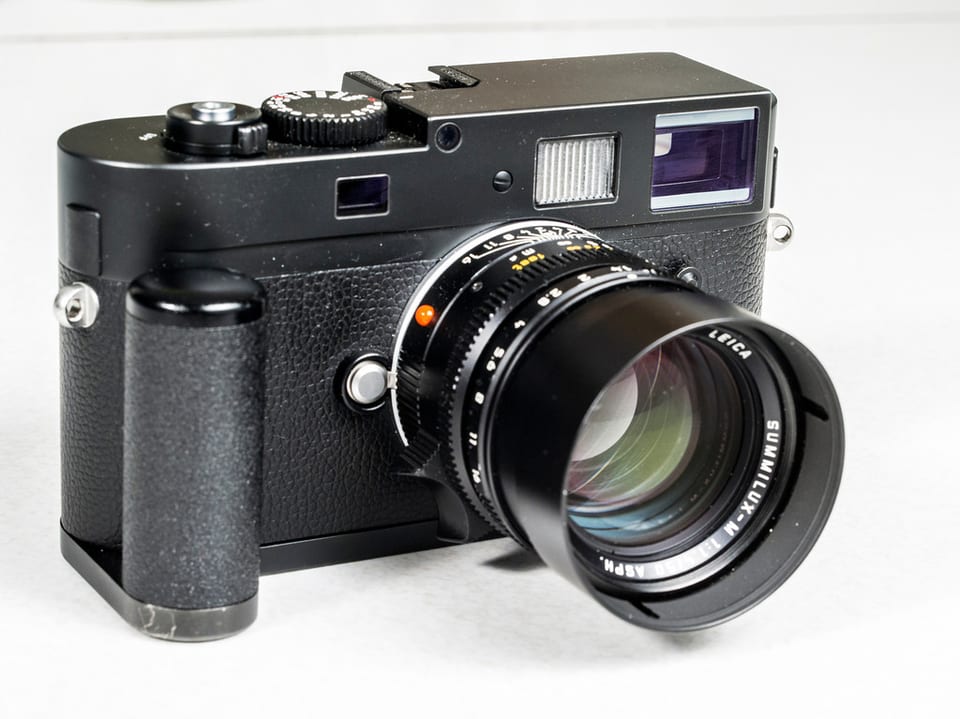
Jul 201115.2 yrs oldM9 (CCD)
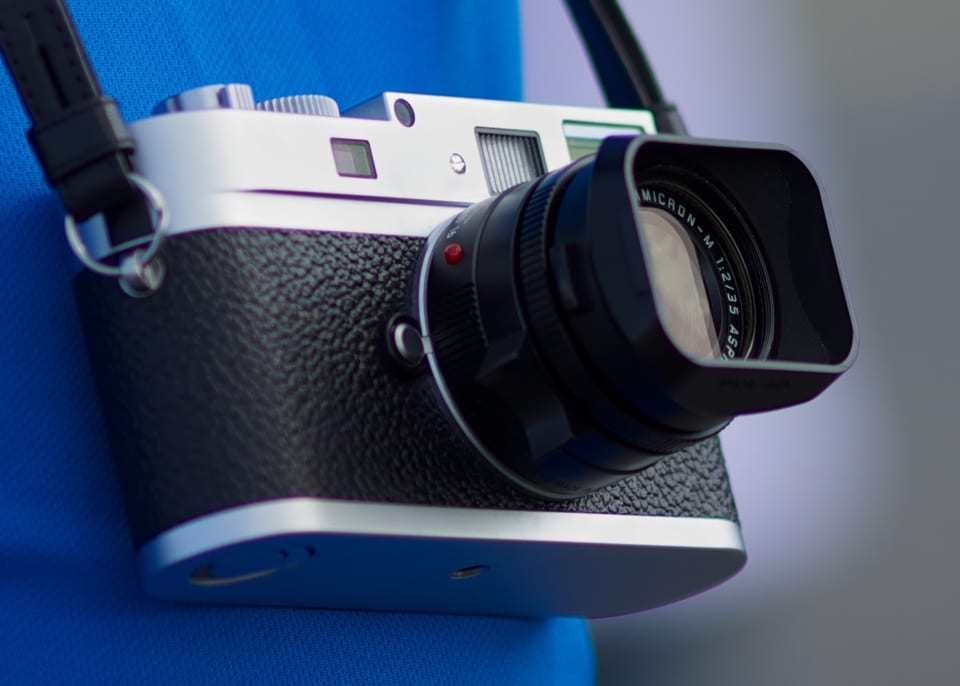
Silver Leica M9-P showing the engraved top plate and no red dot
Ernst Vikne, CC BY-SA 2.0

Leica M9-P

The M9 in a quieter suit

Identical sensor and electronics to the M9. What you pay extra for is a sapphire screen cover, vulcanite covering, and a top plate with the Leica script instead of a red dot. Same corrosion exposure.

Sensor18 MP CCDUsable ISO640 clean / 1,250 maxShutter1/4000 mech, 1/180 syncScreen2.5" 230k sapphire, no LVCardsSD/SDHC ≤32 GBSealingNoneClose focus0.7 mSize600 g · 37 mm deepReliabilityD

How to recognize it

  • No red dot and no "M9" lettering; Leica script engraved on the top plate
  • Vulcanite covering, coarser than the M9 leatherette
  • Sapphire screen cover (reflections look different from plain glass)
  • Frame-line lever present, which separates it from the M-E
  • Black paint or silver chrome

Reliability history

  • Sensor cover-glass corrosion. One of the four affected CCD models. Same symptoms, same lack of a replacement marker, same end of Leica support in Aug 2020. Kolari repair available.

Used price

~$4,800 $3,750–$6,400 elsewhere

No stock at B&H Used, KEH or Adorama Used on the observation date. MPB was also out of stock.

Fallback: sold prices from late 2025 ($3,750, $4,250, $6,400); the $6,400 sale was a "CCD ID 15" replaced-sensor body. Current asks cluster $4,600 to $6,400, with pristine replaced-sensor examples to $8,950. Summimarket eBay sold data.

Launch MSRP $7,995.

ISO Same sensor and processing as the M9.

Shutter Same motorized shutter as the M9; the vulcanite does not change the sound.

Screen The sapphire-crystal cover is the one real upgrade: it removes the scratch-prone screen as a wear item. Still 230k dots, still no live view.

Cards Inherits the M9 card behavior in full: no SDXC, avoid fast SanDisk cards, stay on the last firmware.

Sealing No sealing claim.

Close focus Rangefinder minimum, hard limit without live view.

Battery Shared with M8, M9, M-E and the CCD Monochrom. Genuine cells scarce, third-party plentiful.

Firmware Shares the M9 firmware line, frozen at 1.216.

Verdict. The nicest CCD M to own, and it carries the same sensor risk as the M9. Pay the premium only for a body with a replaced sensor; otherwise the extra money buys cosmetics on a camera that may need a $999 repair.

Sep 201214 yrs oldM9 (CCD)
Leica M Monochrom with a 50 mm Summilux and grip, three-quarter view on white
JamesPFisherIII, CC BY 3.0
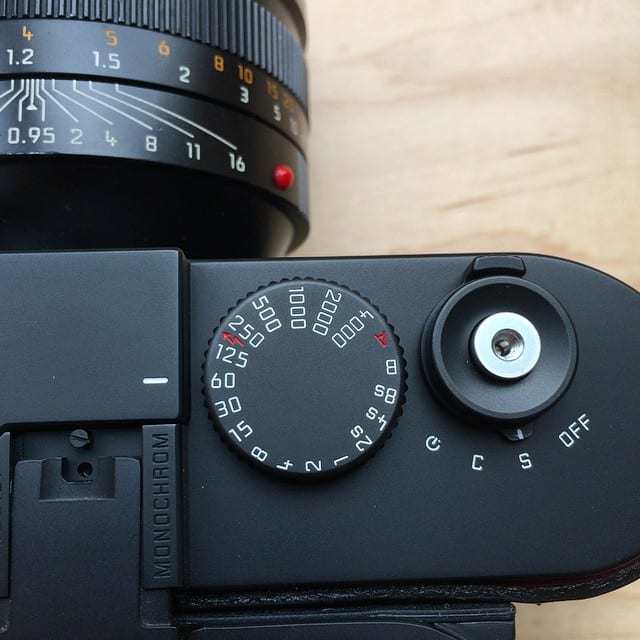
Close-up of the MONOCHROM engraving on the frame-line lever cover
MONOCHROM engraving on the lever cover. Christopher Michel, CC BY 2.0

Leica M Monochrom (CCD)

The original black-and-white-only M

The M9's Kodak CCD with the color filter array left off, so every pixel records luminance. About two stops more usable sensitivity than the color M9 and more detail, in exchange for never shooting color. The riskiest used buy in this guide.

Sensor18 MP CCD monoUsable ISO3,200 clean / 6,400 maxShutter1/4000 mech, 1/180 syncScreen2.5" 230k, no LVCardsSD/SDHC ≤32 GBSealingNoneClose focus0.7 mSize600 g · 37 mm deepReliabilityD

How to recognize it

  • "Leica M Monochrom" on the top plate, no red dot
  • Frame-line lever present
  • Slim 37 mm body with a 2.5" screen; the CMOS Typ 246 is 42 mm deep with a 3" screen
  • Black chrome until the 2014 silver variant

Reliability history

  • Sensor cover-glass corrosion with no repair path. Same defect as the M9, but Kolari Vision does not service the CCD Monochrom and Leica stopped replacing the sensor in Aug 2020. A corroded CCD Monochrom is worth trade-in credit and nothing else. Inspect at f/16 before buying and price the risk as total loss.

Used price

$3,836 typical · $3,836

One plain body in stock across the three retailers; the B&H Drifter set is a limited edition with a lens and is excluded from the range.

Launch MSRP $7,950.

  • KEH $3,836 one body, listed as updated sensor
  • B&H Used $9,999 grade 9, Drifter special edition with 28 mm f/2 lens

ISO Red Dot Forum's comparison: stick to 5000 or 6400; at 10,000 the white speckle overruns the image. Its ISO 2500 looks like the color M9 at 320.

Shutter Same M9 shutter with the two-stage sound.

Screen Whether the cover is sapphire could not be confirmed. No live view.

Cards Same platform card limits as the M9: no SDXC, 64 GB cards will not mount.

Sealing No sealing claim.

Close focus Rangefinder minimum, hard limit.

Battery Same as the M9.

Firmware Frozen at 1.022 (Nov 2017).

Verdict. Beautiful files, no safety net. Unless the seller can prove a corrosion-resistant sensor, buy the CMOS Monochrom (Typ 246) or the M10 Monochrom instead.

Nov 201213.8 yrs oldM9 (CCD)
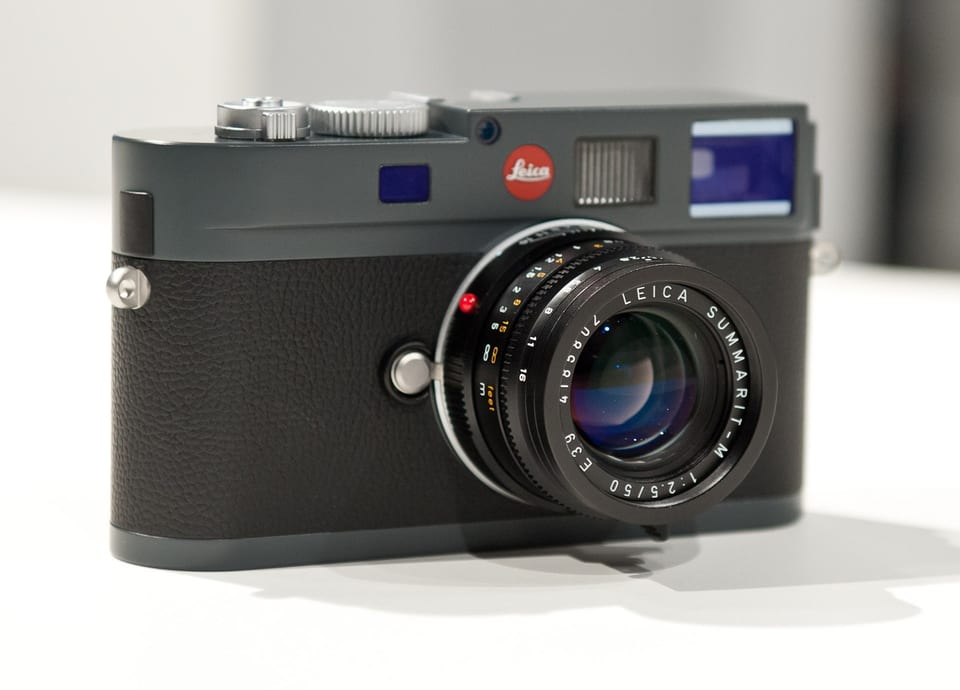
Leica M-E Typ 220 in anthracite grey with a Summarit lens, front view on white
Ben Fredericson, CC BY 2.0
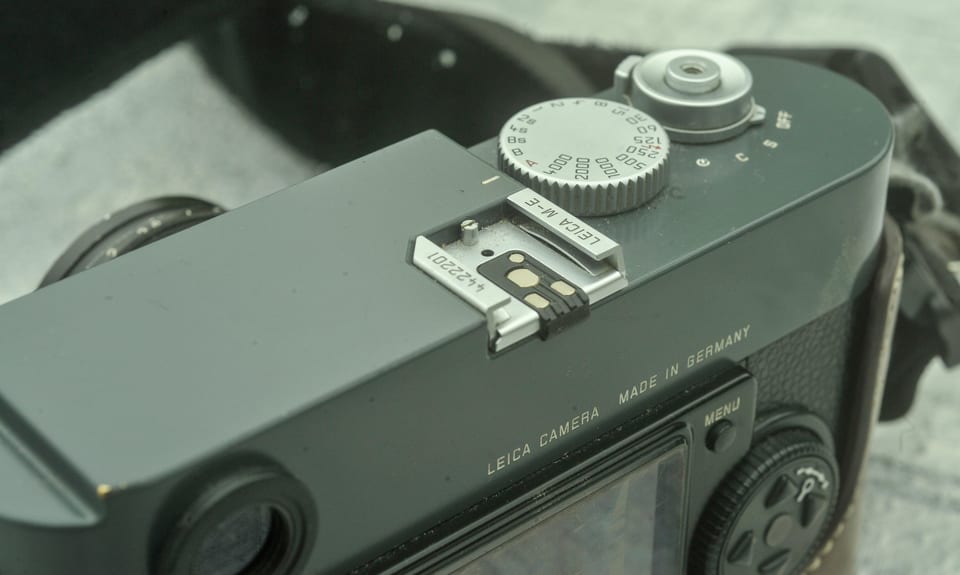
Top plate of the anthracite Leica M-E showing no frame-line preview lever
Top plate: shutter dial, hot shoe, no preview lever. BUTTON74, CC BY-SA 4.0

Leica M-E (Typ 220)

The cheapest way into a CCD M

An M9 with the frame-line preview lever and USB port removed, painted anthracite grey, sold for $1,500 less. Same sensor, same files, same corrosion.

Sensor18 MP CCDUsable ISO640 clean / 1,250 maxShutter1/4000 mech, 1/180 syncScreen2.5" 230k, no LVCardsSD/SDHC ≤32 GBSealingNoneClose focus0.7 mSize585 g · 37 mm deepReliabilityD

How to recognize it

  • Anthracite grey paint only, with the red dot present
  • No frame-line preview lever beside the mount, the most reliable tell
  • No USB port
  • Plain-glass 2.5" screen, 37 mm deep (the later M-E Typ 240 is 42 mm deep with a 3" screen)

Reliability history

  • Sensor cover-glass corrosion. Same defect and same end of Leica support as the M9. Bodies with disclosed corrosion trade at a steep discount, roughly $1,800 against $4,300 for listings that say nothing, which tells you how the market prices the risk. Kolari repair available.

Used price

~$4,273 $4,273 elsewhere

No stock at B&H Used, KEH or Adorama Used on the observation date. Thinnest data of any body here; treat the figure as an anchor, not a market price.

Fallback: a stale asking price; no in-stock US unit was found at MPB, KEH or Kamerastore. KEH's out-of-stock listing flags "original sensor, not covered by warranty", which is the disclosure to look for. Kamerastore (sold out).

Launch MSRP $5,450.

ISO Same as the M9.

Shutter Same M9 shutter and motorized re-cock.

Screen Plain glass, not sapphire. No live view.

Cards No SDXC. It shipped after the card-fix firmware so out-of-box behavior is better than an early M9. No USB port, so a card reader is the only way to get files off.

Sealing No sealing claim.

Close focus Rangefinder minimum, hard limit without live view.

Battery Same as the M9.

Firmware Shares the M9 firmware line.

Verdict. If you want CCD files and nothing else, this is the one: the missing lever and USB port cost nothing in practice. Same rule as the M9: replaced sensor or Kolari receipt, or price it as a gamble.

Typ 240 generation 2012–2019

Mar 201313.5 yrs oldTyp 240
Leica M Typ 240 body with cap, studio front view on white
Rama, CC BY-SA 3.0 FR

Leica M (Typ 240)

The first CMOS M: live view, video, big battery

A 24 MP CMOSIS sensor brought live view, an EVF socket, 1080p video and a battery twice the size. The price was 5 mm of extra depth and 95 g over the M9. Usable ISO jumped two stops.

Sensor24 MP CMOSUsable ISO1,600 clean / 3,200 maxShutter1/4000 mech, 1/180 syncScreen3" 920k Gorilla, LVCardsSD/SDHC/SDXCSealingSplash resistantClose focus0.7 mSize680 g · 42 mm deepReliabilityB

How to recognize it

  • Red dot on the front
  • Six-button column left of the 3" screen (the M10 has three)
  • No ISO dial on the top plate
  • Live view button and video record button
  • 42 mm deep; noticeably thicker in the hand than any other M

Reliability history

  • Thin sourcing, not a clean bill. Forum reports of shutter lock-ups and frame-line LED faults exist but could not be tied to a documented failure rate. Rangefinder drift is ordinary M wear; DAG quotes roughly $140 for a Typ 240 calibration, Leica USA several hundred.
  • Aging platform. Firmware frozen since Feb 2021 and the BP-SCL2 cells on early bodies are past ten years. Budget for a fresh battery.

Used price

$3,400 typical · $3,200–$3,636

KEH had none. The B&H "Leica 60" edition at $14,999 is a collector set and excluded.

Launch MSRP $6,950.

  • B&H Used $3,200 black, with multi-function handgrip
  • Adorama Used $3,636 Average, 100 Year Anniversary Edition black

ISO Clean to 1600, usable to 3200 with noise reduction, banding shows at 6400. Pull to 100 available.

Shutter Metal focal-plane shutter with a motorized cocking system, quieter than the M9 but still a two-part sound. Leica later advertised the M-D (Typ 262) cocking as quieter than this one.

Screen First M with live view and focus peaking. Takes the plug-in Visoflex EVF2 through the accessory socket; that socket disappeared on the M10, so EVFs do not cross generations.

Cards No documented card problems. The M9 card horror stories do not apply here.

Sealing The first M where Leica used "sealed against dust and water spray" language. No IP rating, and the lens mount and lenses are unsealed regardless.

Close focus Rangefinder minimum, but this is the first M where live view or the EVF lets you focus closer with lenses that allow it.

Battery 7.4 V 1800 mAh, physically larger than the M9 or M10 packs and not interchangeable. Widely quoted around 500 shots. Genuine spares still sold; the cells are now a decade old on early bodies.

Firmware Final release 2.1.0.0, Feb 2021.

Verdict. The cheapest live-view M and still a complete camera. Buy it if the depth doesn't bother you in the hand; try an M10 first, because most people who handle both pay the difference.

Sep 201412 yrs oldTyp 240
Leica M-P Typ 240 with a 35 mm Summicron, front view on white
Ferencvizi, CC BY-SA 4.0
Rear of the Leica M-P Typ 240 showing the six-button column and 3-inch screen
Rear: the Typ 240 generation six-button column. Ferencvizi, CC BY-SA 4.0

Leica M-P (Typ 240)

Typ 240 with sapphire, a bigger buffer, and no dot

Same sensor and shutter as the Typ 240. Adds a sapphire screen cover, a 2 GB buffer that doubles burst depth, the frame-line preview lever, and the engraved top plate.

Sensor24 MP CMOSUsable ISO1,600 clean / 3,200 maxShutter1/4000 mech, 1/180 syncScreen3" 921k sapphire, LVCardsSD/SDHC/SDXCSealingSplash resistantClose focus0.7 mSize680 g · 42 mm deepReliabilityB

How to recognize it

  • No red dot; Leica script engraved on the top plate
  • Frame-line preview lever beside the mount
  • Sapphire screen cover
  • Has live view and video, which rules out the M262 and M-D
  • Black paint or silver chrome

Reliability history

  • Same platform as the Typ 240. No -P-specific failure mode reported. Firmware frozen since 2021, batteries aging.

Used price

$5,000 typical · $4,344–$5,652

Only the Safari variant was in stock; a standard black or silver M-P should sit at or below the low end of this band.

Launch MSRP $7,950.

  • KEH $4,344 Safari (olive) variant only, band across grades
  • KEH $5,652 Safari, top of band

ISO Same as the Typ 240.

Shutter Same mechanism as the Typ 240; the -P is not the quiet one in this generation.

Screen Sapphire crystal cover. Live view, Visoflex EVF2 via the accessory socket.

Cards 2 GB internal buffer, double the Typ 240, so bursts go about 24 frames before slowing.

Sealing Same splash-and-dust language as the Typ 240. No IP rating.

Close focus Rangefinder minimum; live view goes closer.

Battery Same as the Typ 240.

Firmware Shares the Typ 240 firmware line.

Verdict. Worth a modest premium over the Typ 240 for the buffer and the unscratchable screen. Don't pay more than that; it is the same camera.

May 201511.3 yrs oldTyp 240
Stand-in photo: a Leica M-P Typ 240, which shares the Monochrom Typ 246 bodystand-in
Shown: M-P (Typ 240). No freely licensed photo of the Typ 246 exists; it is the same body without the red dot and with "MONOCHROM" on the lever cover. Ferencvizi, CC BY-SA 4.0

Leica M Monochrom (Typ 246)

The CMOS Monochrom, and the safe one

The 24 MP CMOS sensor without a color filter array, in the Typ 240 body with live view, video and a sapphire screen. Base ISO 320, usable to 10,000. None of the CCD Monochrom's corrosion risk.

Sensor24 MP CMOS monoUsable ISO6,400 clean / 10,000 maxShutter1/4000 mech, 1/180 syncScreen3" 921k sapphire, LVCardsSD/SDHC/SDXCSealingSplash resistantClose focus0.7 mSize680 g · 42 mm deepReliabilityB

How to recognize it

  • No red dot, black chrome, "MONOCHROM" on the lever cover
  • 42 mm-deep body with a 3" screen, which separates it from the slim 2.5"-screen CCD Monochrom
  • Records video and has live view, unlike the M262 and M-D
  • Files have no color channel

Reliability history

  • Same platform as the Typ 240. No 246-specific failure mode reported. Firmware frozen since 2021. The important thing is what it does not have: a corroding CCD.

Used price

$4,115 typical · $4,036–$4,194

KEH only.

Launch MSRP $7,450.

  • KEH $4,036 band across grades, three in stock
  • KEH $4,194 top of band

ISO Red Dot Forum: no qualms at ISO 10,000, where the CCD Monochrom has to stop at 5000 or 6400. Noise is luminance-only grain with no chroma blotching, so it looks like film rather than digital.

Shutter Typ 240 shutter and cocking mechanism.

Screen Live view with focus peaking and 10x magnification. Sapphire cover. Visoflex EVF2 via the accessory socket.

Cards No documented card problems.

Sealing Shares the 240-generation body.

Close focus Rangefinder minimum; live view goes closer.

Battery Same pack as the Typ 240.

Firmware Final release 1.1.0.0, Feb 2021.

Verdict. The right first Monochrom for most people: modern sensor behavior, live view, and a fraction of the M10 Monochrom's price. Buy this before you gamble on a CCD Monochrom.

Dec 201510.8 yrs oldTyp 240
Leica M Typ 262 with a 28 mm Elmarit, front view on a wood table
Matthew T Rader, CC BY-SA 4.0
Rear of the Leica M Typ 262 with the screen on, showing the WB button in place of live view
Rear: WB button where the Typ 240 has LV. Matthew T Rader, CC BY-SA 4.0

Leica M (Typ 262)

The stripped Typ 240: no live view, no video, lighter

The Typ 240 sensor and body with live view and video removed, an aluminum top plate instead of brass, a quieter shutter and a simpler menu. Launched at $5,195, the cheapest new digital M ever.

Sensor24 MP CMOSUsable ISO1,600 clean / 3,200 maxShutter1/4000 mech, 1/180 sync, quieterScreen3" 921k, no LVCardsSD/SDHC/SDXCSealingSplash resistantClose focus0.7 mSize600 g · 42 mm deepReliabilityB

How to recognize it

  • Red dot present
  • No live view button and no video: the rear column reads WB, Play, Delete, ISO, Menu, Set
  • Lighter in the hand than a Typ 240 (aluminum top plate)
  • Same 42 mm body

Reliability history

  • Same platform as the Typ 240. No 262-specific failure mode reported. Firmware frozen since 2021.

Used price

~$3,919 $3,392–$4,500 elsewhere

No stock at B&H Used, KEH or Adorama Used on the observation date.

Fallback: ten active asking prices; US asks cluster $4,300 to $4,500, the low end is European. MPB US was out of stock. UsedCameraTracker.

Launch MSRP $5,195.

ISO Same as the Typ 240. Some sources list ISO 100 as a true base here; treat it as a pull.

Shutter Quieter than the Typ 240. Whether from a revised cocking mechanism or the aluminum top, it is the quietest of the color 240-generation bodies with a screen.

Screen Screen present for review and menus, but no live view and no video. No EVF support.

Cards Standard Typ 240 buffer (1 GB).

Sealing Shares the 240-generation body and its splash-and-dust language.

Close focus Rangefinder minimum, and with no live view it is a hard limit again.

Battery Same pack as the Typ 240.

Firmware Final release 1.1.0.0, Feb 2021.

Verdict. The value pick if you will never use live view: same files as the Typ 240, quieter, lighter, cheaper. If you might ever want an EVF or close focus, buy the Typ 240 instead.

May 201610.3 yrs oldTyp 240
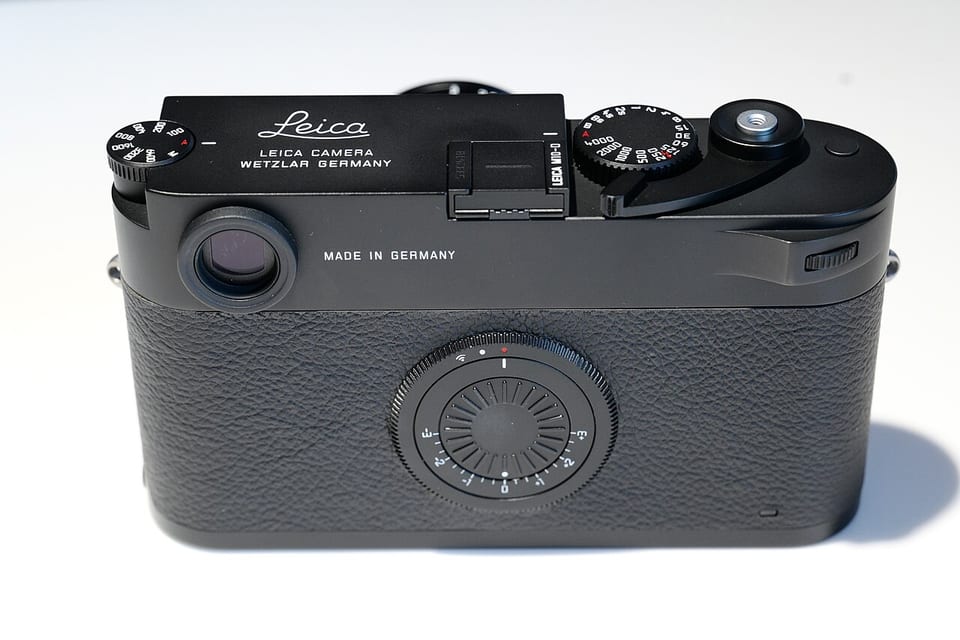
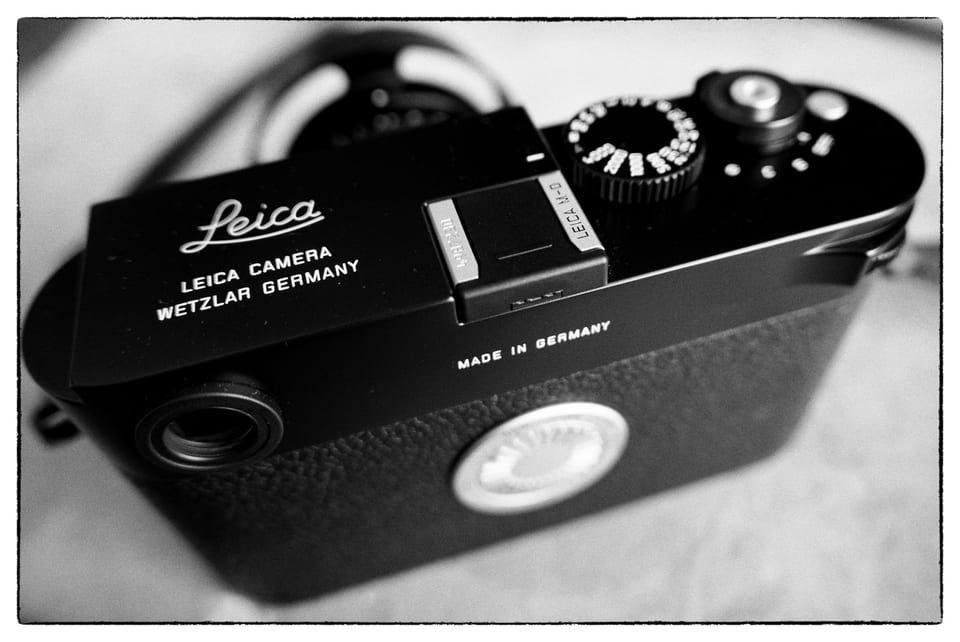
Rear of the Leica M-D Typ 262 showing the blank back plate and large ISO dial
Guido van Nispen, CC BY 2.0
Front three-quarter view of the Leica M-D Typ 262
Front: no red dot, Leica script on top. Xavier León, CC BY 2.0

Leica M-D (Typ 262)

The first screenless digital M

A Typ 262 with the screen deleted and a big ISO dial in its place. No menus, no review, no live view, DNG only. Brass top plate, quieter shutter, and the purest film-like experience Leica has sold in digital.

Sensor24 MP CMOSUsable ISO1,600 clean / 3,200 maxShutter1/4000 mech, 1/180 sync, quieterScreenNoneCardsSD/SDHC/SDXC, DNG onlySealingSplash resistantClose focus0.7 mSize680 g · 42 mm deepReliabilityB

How to recognize it

  • No rear screen; silver ISO dial on the back
  • No red dot; white Leica script on the top plate
  • No thumb lever (the M10-D has a dummy film-advance lever and its ISO dial is on top)
  • Brass top plate with the M9-style step

Reliability history

  • No way to self-diagnose. No screen means you cannot inspect sensor dust, exposure or a card fault without a computer. Bench-test before buying. No mechanical failure mode reported.

Used price

$5,800 typical · $5,135–$6,583

KEH only.

Launch MSRP $5,995.

  • KEH $5,135 band across grades, three in stock
  • KEH $6,583 top of band

ISO Set on the rear dial. You cannot check a high-ISO frame in the field, so know the ceiling before you go out.

Shutter Leica states the cocking system is quieter than the M and M-P (Typ 240). The clearest sourced quiet-shutter claim in this generation.

Screen No screen, no menu, no live view, no video. A silver ISO dial occupies the back. No EVF support.

Cards Records lossless DNG only. With no screen there is nothing to tell you a card failed to write, so test a used body with a known-good card before paying.

Sealing Shares the 240-generation body.

Close focus Rangefinder minimum, hard limit: no screen, no live view.

Battery Same pack as the Typ 240. Real-world life is better with no screen to drive.

Firmware Final release 1.1.0.0, Feb 2021.

Verdict. A niche camera that holds its value because the niche is loyal. Buy it only if you have shot screenless before and liked it; the M10-D adds phone review over Wi-Fi and a thinner body for more money.

M10 generation 2017–2020

Jan 20179.7 yrs oldM10
Leica M10 in black, front view on a stone surface
BUTTON74, CC BY-SA 4.0
Rear of the Leica M10 showing the three-button column
Rear: three buttons, versus six on the Typ 240. BUTTON74, CC BY-SA 4.0

Leica M10

Back to film-M thickness, ISO dial on top

A new 24 MP sensor, base ISO 100, Wi-Fi, three rear buttons instead of six, and a body 4 mm thinner than the Typ 240, the same depth as an M6 or M7. The camera most used buyers end up with.

Sensor24 MP CMOSUsable ISO3,200 clean / 6,400 maxShutter1/4000 mech, 1/180 syncScreen3" 1.04M Gorilla, LVCardsSD/SDHC/SDXCSealingSplash resistantClose focus0.7 mSize660 g · 39 mm deepReliabilityB

How to recognize it

  • Red dot present
  • ISO dial on the left of the top plate, the generation marker
  • Three rear buttons (Play, LV, Menu) plus the d-pad
  • Plastic hot-shoe cover (the M10-P has a metal one)
  • Non-touch screen (the M10-P and M10-R are touch)

Reliability history

  • Battery supply. Not a failure mode, but the BP-SCL5 shortage is the practical risk of owning this generation.
  • Firmware frozen. Final M10 release Nov 2022. A Jan 2026 Leica note claims Noctilux 35 f/1.2 support across all M10 cameras; check the downloads page before assuming it is closed.

Used price

$5,300 typical · $4,956–$5,484

The most widely stocked older body: six listings across all three retailers.

Launch MSRP $6,595.

ISO Clean to 3200, usable to 6400, and 12,500 works in raw at a pinch. Ken Rockwell shoots it at 20,000 to 25,000 in raw; most people will not.

Shutter Mechanical only. No M10-generation body has an electronic shutter; the readout is too slow. The plain M10 is the loud one of the generation; the damped quiet shutter arrived with the M10-P.

Screen Not touch. Live view with a dedicated button. Takes the hot-shoe Visoflex 020; the Typ 240 EVF2 does not fit.

Cards Single slot, no internal storage, no known compatibility issue.

Sealing Leica makes no formal sealing claim for the M10. Third-party teardowns note improved rubber seals along the baseplate and the deleted EVF socket. Overgaard shot his in rain for years; keep the mount dry.

Close focus Rangefinder minimum; closer via live view or the Visoflex 020.

Battery CIPA 210 is the weakest of any digital M (real use is closer to 400 with the finder). The BP-SCL5 is chronically out of stock: it returned to B&H in Aug 2025 after a long gap and sold out again. Buy spares when you see them.

Firmware Final 3.22.23.38, Nov 2022.

Verdict. The default answer. Thin body, ISO dial, plenty of stock at every used dealer. Pay up for the M10-P only if shutter noise matters to you.

Aug 20188.1 yrs oldM10
Leica M10-P body in black, studio front view on white
Ferencvizi, CC BY-SA 4.0
Top plates of an M10 Monochrom and M10-P side by side showing the ISO dials
Top: M10 Monochrom (left) and M10-P (right), ISO dials visible. Bchalifour, CC BY-SA 4.0

Leica M10-P

The quietest shutter Leica has made

An M10 with a heavily damped shutter Leica called the quietest of any M, film or digital, plus a touchscreen, a level, a metal hot-shoe cover and the engraved top plate. Not sapphire, despite the P.

Sensor24 MP CMOSUsable ISO3,200 clean / 6,400 maxShutter1/4000 mech, 1/180 sync, quietestScreen3" 1.04M Gorilla touch, LVCardsSD/SDHC/SDXCSealingSplash resistantClose focus0.7 mSize660 g · 39 mm deepReliabilityB

How to recognize it

  • No red dot; Leica script on the top plate
  • Metal hot-shoe cover matched to the body
  • Touchscreen: the reliable way to tell it from an M10 if the top plate is hidden
  • ISO dial and three-button rear like every M10
  • Black chrome or silver chrome

Reliability history

  • Battery supply. Same BP-SCL5 shortage as the M10.

Used price

$5,900 typical · $5,846–$6,000

B&H only, both silver. Black bodies usually ask a little more.

Launch MSRP $7,995.

ISO Same as the M10.

Shutter Redesigned, mechanically damped shutter about as loud as a Leica Q. Inherited by the M10-R and M10 Monochrom. Still no electronic shutter.

Screen First touch M: swipe playback, pinch zoom, tap to magnify in live view. Gorilla Glass, not sapphire; Leica dropped sapphire for this generation. Adds a level gauge. Visoflex 020.

Cards Same as the M10.

Sealing Same body and same absence of a formal claim as the M10.

Close focus Rangefinder minimum; closer via live view or Visoflex 020.

Battery Same scarce pack as the M10.

Firmware Final 4.22.23.34, Nov 2022.

Verdict. The best used M for most people who can afford the step up: the M10 body with the shutter you actually want. It was cut to $7,795 new in 2020, so don't let anyone price it off the launch MSRP.

Nov 20187.8 yrs oldM10
Rear of the Leica M10-D showing the blank back and fold-out dial
Ferencvizi, CC BY-SA 4.0
Leica M10-D held in two hands with a Zeiss lens
In hand: note the thumb lever. Christopher Michel, CC BY 2.0

Leica M10-D

Screenless, with a phone as the screen

The M10-P internals with no rear screen, a fold-out exposure-compensation dial where the screen would be, a dummy film-advance lever as a thumb rest, and Wi-Fi so the Leica FOTOS app can be your live view and playback.

Sensor24 MP CMOSUsable ISO3,200 clean / 6,400 maxShutter1/4000 mech, 1/180 sync, quietScreenNone; phone via Wi-FiCardsSD/SDHC/SDXCSealingSplash resistantClose focus0.7 mSize660 g · 39 mm deepReliabilityB

How to recognize it

  • No rear screen; fold-out exposure-compensation dial on the back
  • Dummy film-advance lever on the top plate (the M-D has none)
  • ISO dial on top (the M-D puts it on the back)
  • No red dot, Leica script on top

Reliability history

  • Battery supply. Same BP-SCL5 shortage.
  • No self-diagnosis. Bench-test with the FOTOS app before paying.

Used price

~$7,549 $7,158–$8,019 elsewhere

No stock at B&H Used, KEH or Adorama Used on the observation date. The best-supplied of the unlisted bodies.

Fallback: MPB US asks: two Excellent at $7,549, one Like New with box at $8,019, and a European unit at $7,158. UsedCameraTracker recorded one sale at $7,700 in June 2026. MPB US and UsedCameraTracker.

Launch MSRP $7,995.

ISO Same as the M10. Set on the top dial.

Shutter Widely reported as the M10-P damped unit, though Leica never said so explicitly.

Screen No screen, but unlike the M-D it has Wi-Fi: the FOTOS app gives live view, review and settings. Visoflex 020 works for live view on the camera.

Cards Same as the M10. Test the card path before buying: no screen, no warning.

Sealing M10 body.

Close focus Rangefinder minimum; closer via the Visoflex 020 or the phone app.

Battery Same scarce pack; real life is better with no screen.

Firmware Shares the M10 firmware cadence, frozen Nov 2022.

Verdict. The screenless M that gives you the screen back when you need it. If you are choosing between this and the M-D (Typ 262), the phone app and the thinner body are worth the difference.

Jul 20197.2 yrs oldTyp 240
Stand-in photo: a Leica M Typ 240 body, which the M-E Typ 240 sharesstand-in
Shown: M (Typ 240). No freely licensed photo of the M-E (Typ 240) exists; it is this body in anthracite paint with a leather wrap. Rama, CC BY-SA 3.0 FR

Leica M-E (Typ 240)

The Typ 240 reissued cheap, in anthracite

Leica's 2019 entry model: Typ 240 hardware with the 2 GB buffer, 1080p video and a 3" screen, painted anthracite with a leather wrap, at $3,995 new. The last new 240-generation body sold.

Sensor24 MP CMOSUsable ISO1,600 clean / 3,200 maxShutter1/4000 mech, 1/180 syncScreen3" 921k, LVCardsSD/SDHC/SDXCSealingSplash resistantClose focus0.7 mSize680 g · 42 mm deepReliabilityB

How to recognize it

  • Anthracite paint with a black leather wrap
  • 42 mm deep with a 3" screen; the 2012 M-E (Typ 220) is 37 mm with a 2.5" screen
  • Do not pay a limited-edition premium: the "700 units" claim on Wikipedia is unsourced

Reliability history

  • Same platform as the Typ 240. No M-E-specific failure mode. The youngest bodies in the generation, so the least worn. Firmware not listed separately; it tracks the Typ 240 line.

Used price

~$3,799 $3,799 elsewhere

No stock at B&H Used, KEH or Adorama Used on the observation date.

Fallback: one unit in stock, Excellent, with charger and battery and a six-month warranty. The only verified in-stock US example. MPB US.

Launch MSRP $3,995.

ISO Same as the Typ 240.

Shutter Typ 240 shutter.

Screen Wikipedia credits it with 1080p video and the 2 GB buffer, which points to Typ 240 hardware with live view rather than 262 hardware. Confirm live view on the body before buying if it matters.

Cards 2 GB buffer.

Sealing Shares the 240-generation body.

Close focus Rangefinder minimum; live view goes closer.

Battery Same pack as the Typ 240, and these are the youngest cells in the generation.

Firmware Tracks the Typ 240 line, frozen Feb 2021.

Verdict. The newest 240-generation bodies at the lowest 240-generation price. If a Typ 240 is the right camera for you, look for one of these first.

Jan 20206.7 yrs oldM10
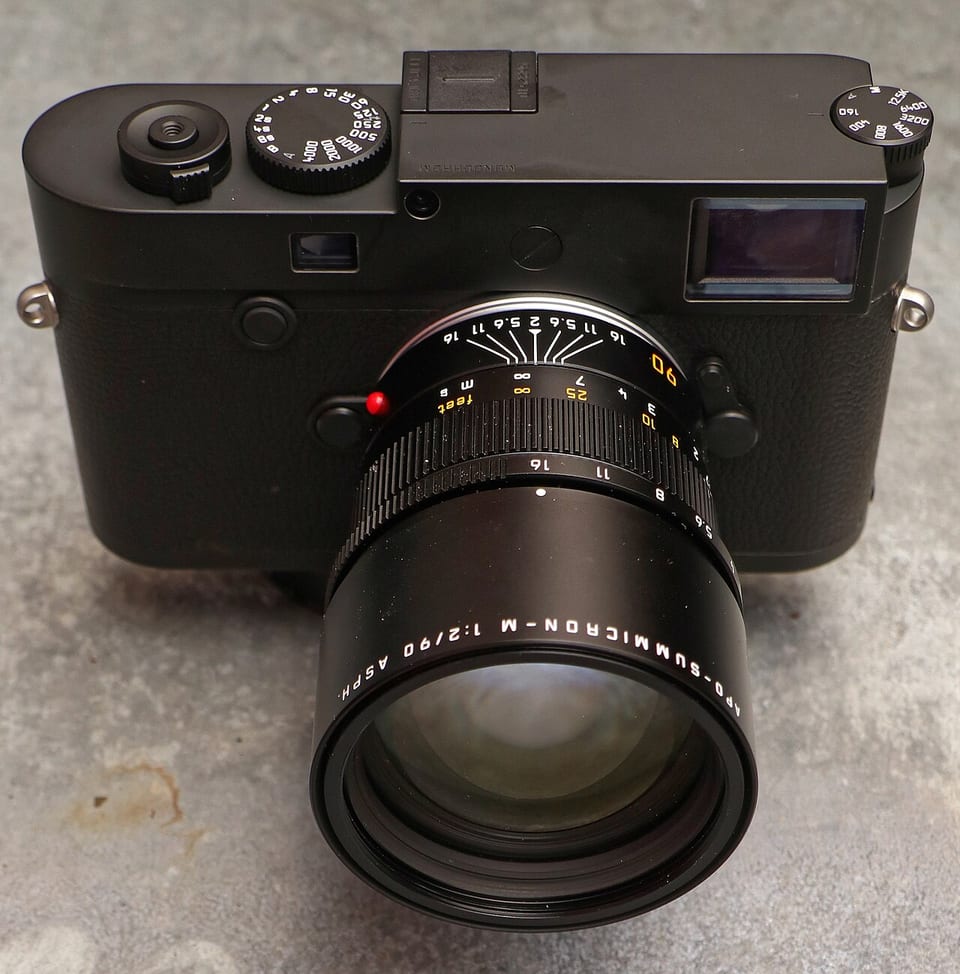
Leica M10 Monochrom with a 90 mm APO-Summicron, front view on concrete
Burkhard Mücke, CC BY-SA 4.0
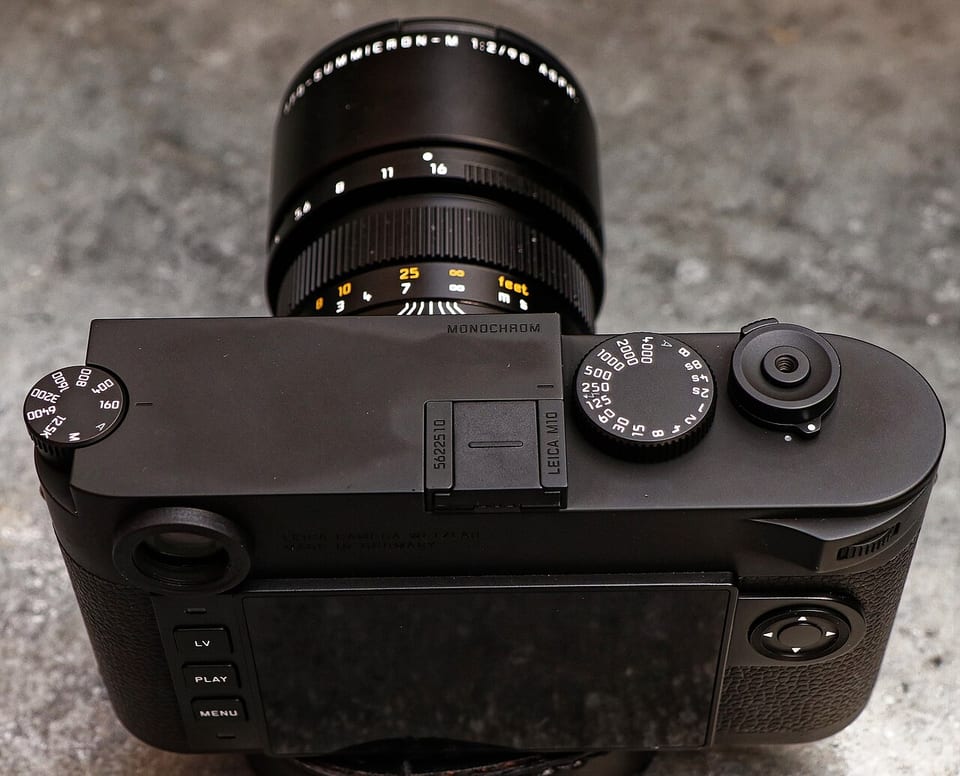
Top view of the Leica M10 Monochrom showing the MONOCHROM engraving and ISO dial
Top: MONOCHROM engraving, ISO dial starting at 160. Burkhard Mücke, CC BY-SA 4.0

Leica M10 Monochrom

40 MP black and white, ISO to 100,000

A 40 MP monochrome sensor in the M10-P body with the quiet shutter, base ISO 160, and a top ISO of 100,000 that is genuinely usable well past 25,000. Black only, no red dot, no color ever.

Sensor40 MP CMOS monoUsable ISO12,500 clean / 25,000 maxShutter1/4000 mech, 1/180 sync, quietScreen3" 1.04M, LVCardsSD/SDHC/SDXCSealingSplash resistantClose focus0.7 mSize660 g · 39 mm deepReliabilityB

How to recognize it

  • Black only, no red dot, discreet engraving
  • ISO dial bottoms out at 160
  • Files have no color channel
  • M10 body with the top-plate ISO dial

Reliability history

  • Battery supply. Same BP-SCL5 shortage.
  • Calibration sensitivity. Budget for a rangefinder check; 40 MP makes small errors visible.

Used price

$6,475 typical · $6,399–$7,117

The Leitz Wetzlar edition is excluded from the range.

Launch MSRP $8,295.

ISO Luminance-only grain that stays film-like. 12,500 is clean, 25,000 is usable, and 50,000 prints small. Base is 160, so bright daylight with fast lenses wants an ND filter.

Shutter M10-P damped shutter. No electronic shutter.

Screen Sources disagree on touch (B&H says yes, Wikipedia says no); B&H is right. Gorilla Glass. Visoflex 020.

Cards 40 MP DNGs are about 80 MB, so card speed matters more here than on the 24 MP bodies.

Sealing M10 body.

Close focus Rangefinder minimum; closer via live view or Visoflex 020. At 40 MP, rangefinder calibration error shows more than on the 24 MP bodies.

Battery Same scarce pack.

Firmware Shares the M10 cadence, frozen Nov 2022.

Verdict. The value Monochrom: most of the M11 Monochrom's low-light ability in a thinner body for much less money. The one to buy if black and white is all you shoot.

Jul 20206.2 yrs oldM10
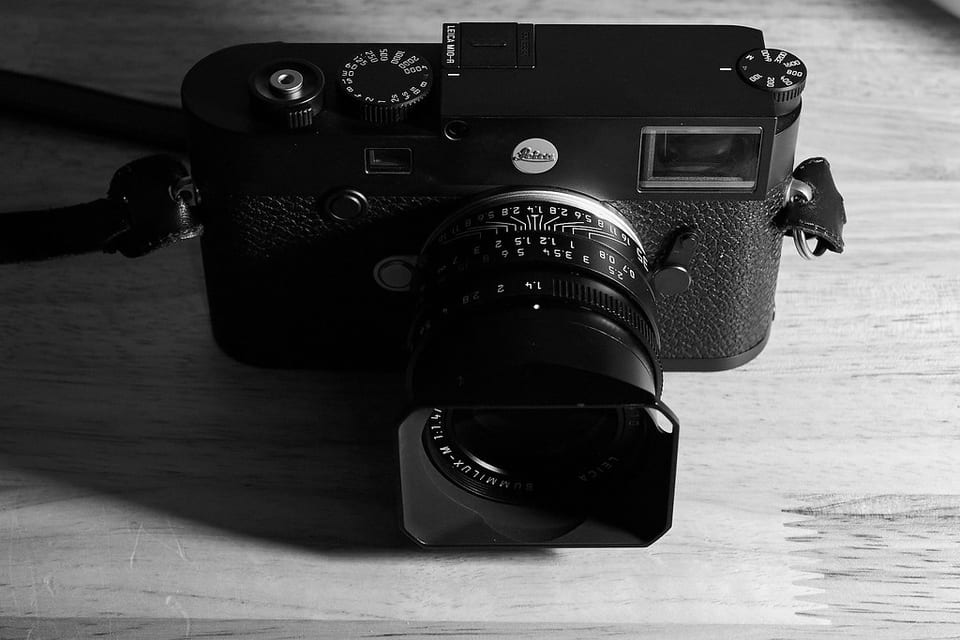
Leica M10-R on a wood table, black-and-white photo showing the top-plate engraving
Jack Baty, CC BY-SA 2.0

Leica M10-R

40 MP color in the M10-P body

A 40 MP color sensor with base ISO 100, 13.5 stops of dynamic range, a 16-minute maximum exposure and the M10-P quiet shutter and touchscreen. Externally almost indistinguishable from an M10-P.

Sensor40 MP CMOSUsable ISO3,200 clean / 6,400 maxShutter1/4000 mech, 1/180 sync, quietScreen3" 1.04M Gorilla touch, LVCardsSD/SDHC/SDXCSealingSplash resistantClose focus0.7 mSize660 g · 39 mm deepReliabilityB

How to recognize it

  • Shares the M10-P shell; cosmetics are unreliable
  • Confirm on the info screen or by DNG size: 7864×5200 px, not 5952×3992
  • Black chrome or silver chrome
  • Leica script on top, no red dot on most units

Reliability history

  • Battery supply. Same BP-SCL5 shortage.
  • Calibration sensitivity. 40 MP exposes small rangefinder errors.

Used price

$7,250 typical · $7,150–$7,287

Range covers the standard chrome finishes; the black-paint variant carries a $2,500 to $3,000 collector premium.

Launch MSRP $8,295.

  • B&H Used $7,150 grade 8+, black chrome
  • KEH $7,287 silver chrome
  • KEH $9,901 black paint (20062), band
  • KEH $10,200 black paint, top of band

ISO Slightly better than the M10 at the same ISO once downsampled to 24 MP. Same practical ceilings.

Shutter M10-P damped shutter. Long exposures extended to 16 minutes. No electronic shutter.

Screen Same as the M10-P.

Cards 40 MP DNGs; use a fast card.

Sealing M10 body.

Close focus Rangefinder minimum. At 40 MP, calibration error with fast lenses at close range shows first; budget for a check.

Battery Same scarce pack.

Firmware Final 30.22.23.34, Nov 2022.

Verdict. High resolution without the M11's price, electronic shutter or USB-C. If you print big and don't need the M11 extras, this is the sweet spot; if you don't print big, the M10-P is the same camera for less.
M11 generation 2022–present

Jan 20224.7 yrs oldM11
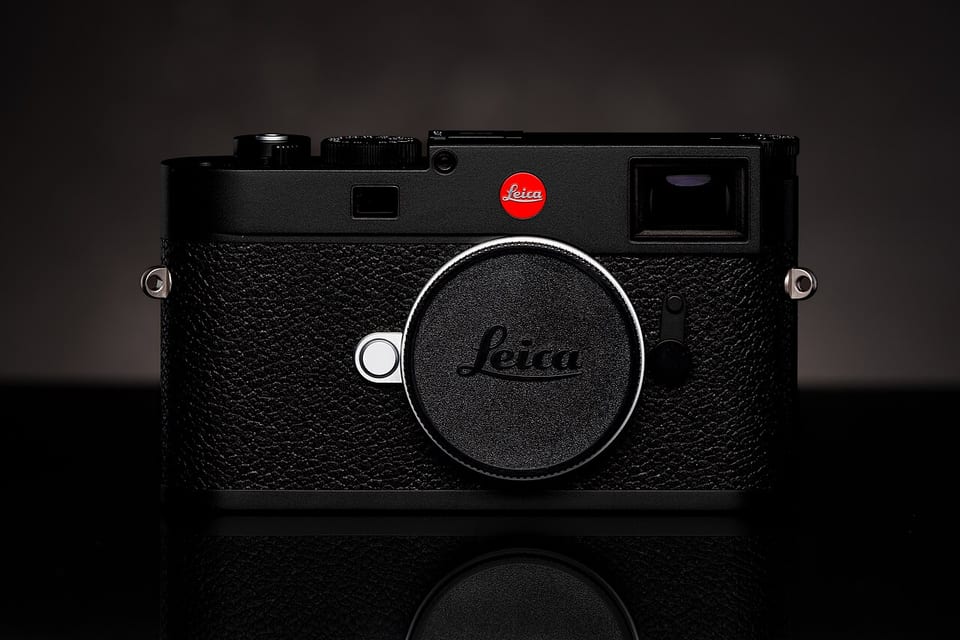
Leica M11 body with cap, dead-on front view in dark studio lighting
Henry Söderlund, CC BY 2.0
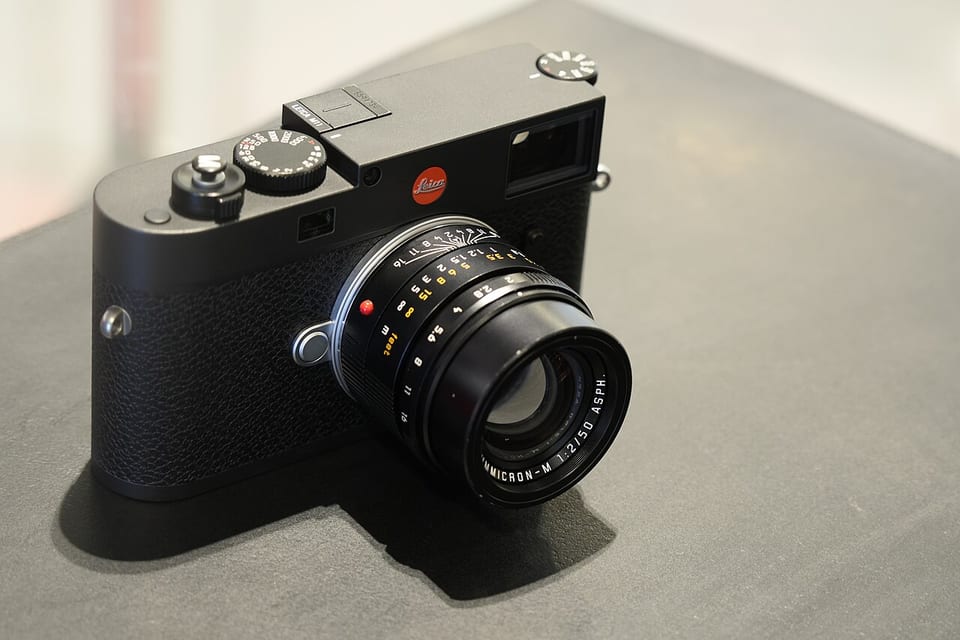
Leica M11 with a 50 mm Summicron on a display plinth
With a 50 mm Summicron. Peachyeung316, CC BY-SA 4.0

Leica M11

60 MP BSI, electronic shutter, no baseplate

A 60 MP back-illuminated sensor with selectable 60/36/18 MP raw, base ISO 64, an electronic shutter to 1/16,000, 64 GB internal storage, USB-C charging, and the removable baseplate gone after 68 years. Black is aluminum and 110 g lighter than silver.

Sensor60 MP CMOSUsable ISO6,400 clean / 12,500 maxShutter1/4000 mech + 1/16000 e-shutter, 1/180 syncScreen2.95" 2.33M touch, LVCardsSD UHS-II + 64 GB internalSealingSplash resistantClose focus0.7 mSize530 g · 38.5 mm deepReliabilityC

How to recognize it

  • Red dot on the front (the M11-P, M11-D and Monochrom delete it)
  • No removable baseplate; a body sold "with spare baseplate" is not an M11
  • Black = aluminum top, light; silver = brass top, heavy
  • 64 GB internal memory, not 256
  • Toughened glass screen, no Content Credentials

Reliability history

  • Launch-era freezing. Intermittent freezes needing a battery pull, worst at startup, across firmware 1.2 and 1.3; fixed in 1.6.1 (Mar 2023). A used body on current firmware is fine; confirm it is on 2.6.1.
  • Bricking during firmware update. Early adopters bricked bodies with a corrupt firmware file on the card. Fix: format in-camera, re-copy the file to the card root.
  • Battery catch. With no baseplate the battery sits on a catch, and owners report it not engaging so the battery drops out, or the release sticking. Test it on any used M11-generation body.
  • Card and internal-memory corruption. Reported from firmware 2.0.2 on the M11 and M11 Monochrom.

Used price

$7,500 typical · $7,359–$7,766

KEH only; no used M11 at B&H or Adorama. Glossy black excluded from the range. The standard M11 is no longer sold new; the Glossy Black finish lists at $10,400 at Leica USA.

Launch MSRP $8,995.

  • KEH $7,359 silver chrome
  • KEH $7,367 black paint, band across grades (four in stock)
  • KEH $7,766 black paint, top of band
  • KEH $8,591 glossy black paint

ISO Red Dot Forum calls it mind-boggling to 10,000; Amateur Photographer puts the practical limit near 12,500 and says avoid 25,000 and 50,000. Dual conversion gain.

Shutter Mechanical shutter is louder and less crisp than the M10 because the camera meters off the sensor and cycles the blades before exposure. Electronic shutter is silent but reads out in about 1/10 s: moving subjects warp, hand shake skews at nominal 1/2000, and LED light bands. No flash with the electronic shutter.

Screen Toughened glass, not sapphire (that is the M11-P and Monochrom). Takes the tilting Visoflex 2.

Cards First M with internal memory and a full UHS-II slot. Owners documented card and internal-memory corruption from firmware 2.0.2; which release fixed it is not stated by Leica. Run current firmware.

Sealing No IP rating and no formal claim. Leica describes rubber seals against light showers and dust and declines to call it weatherproof, citing the unsealed lens line.

Close focus Rangefinder minimum; closer via live view or Visoflex 2, where the rangefinder patch is no longer reliable.

Battery CIPA about 700, or about 1,700 with the optical finder only. Charges in-camera over USB-C. Readily available new.

Firmware Still supported: 2.6.1 (Jan 2026) added Noctilux-M 35 f/1.2 support; 2.6.0 (Oct 2025) added white-balance fine-tuning and lens-profile override.

Verdict. The best sensor in the guide and the most modern body, with a launch-era bug history that firmware has fixed. Buy black for weight, check the battery catch, and update to 2.6.1 before judging it.

Apr 20233.4 yrs oldM11
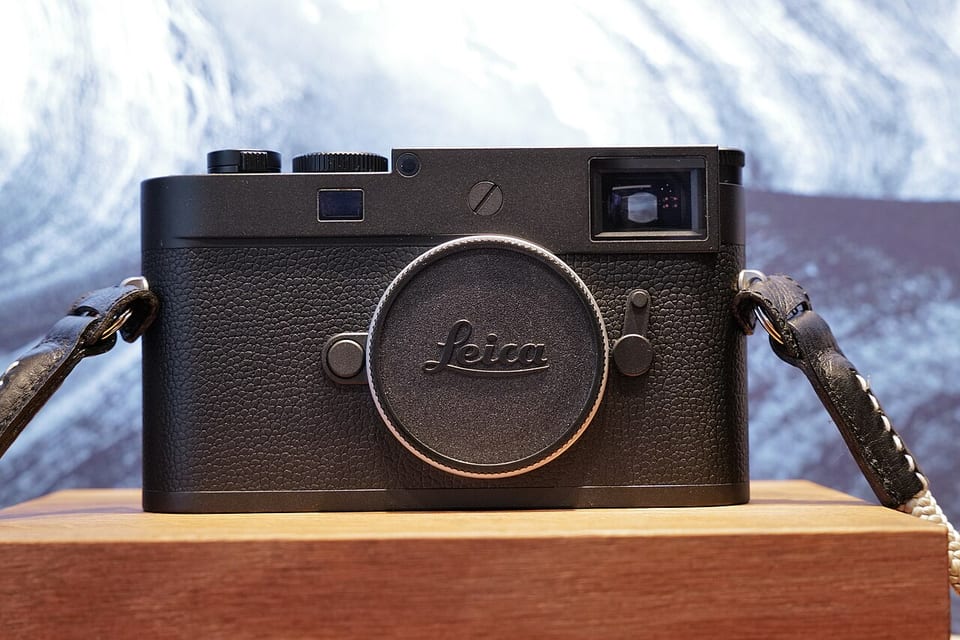
Leica M11 Monochrom body, front view on a wooden block
Ferencvizi, CC BY-SA 4.0
Leica M11 Monochrom with a 35 mm APO-Summicron
All-black: no dot, black-on-black engraving. Ferencvizi, CC BY-SA 4.0

Leica M11 Monochrom

60 MP black and white, ISO to 200,000

The M11 sensor without a color filter array: base ISO 125, top ISO 200,000, 15 stops of dynamic range, 256 GB internal storage, sapphire screen, and an all-black body with a screw where the red dot would be.

Sensor60 MP CMOS monoUsable ISO25,000 clean / 50,000 maxShutter1/4000 mech + 1/16000 e-shutter, 1/180 syncScreen2.95" 2.33M touch sapphire, LVCardsSD UHS-II + 256 GB internalSealingSplash resistantClose focus0.7 mSize540 g · 38.5 mm deepReliabilityB

How to recognize it

  • No red dot; a screw sits in its place
  • "MONOCHROM" engraved black-on-black on the top plate
  • Grey "A" on the ISO dial, dark-tinted finder coating
  • ISO dial bottoms out at 125, files have no color channel
  • Sapphire screen, 256 GB internal

Reliability history

  • Shipped after the freeze fix. Launched Apr 2023, after firmware 1.6.1, so it missed the launch-era freezing. Shares the card-corruption reports and the battery-catch mechanism.

Used price

$10,729 typical · $10,498–$10,866

Used saves about $500 against the $11,050 new price.

Sold new at $11,050.

Launch MSRP $9,195.

  • B&H Used $10,498 grade 10
  • KEH $10,729 band across grades, three in stock
  • KEH $10,866 top of band

ISO Reviewers describe the noise as pleasing luminance grain with no chroma; nobody publishes a hard ceiling. 25,000 is a safe working figure and 50,000 still prints. Base 125 means an ND filter in daylight with fast glass.

Shutter Same as the M11, including the slow electronic readout and the mechanical shutter that is louder than an M10 Monochrom.

Screen Sapphire cover glass. Visoflex 2.

Cards Named alongside the M11 in the firmware 2.0.2 corruption thread. Run current firmware.

Sealing Same as the M11.

Close focus Rangefinder minimum; closer via live view or Visoflex 2.

Battery Same as the M11.

Firmware Still supported on the shared M11 firmware line.

Verdict. The best monochrome sensor Leica has made. Buy it if you already know you are a black-and-white shooter; otherwise the M10 Monochrom gets you most of the way for much less.

Oct 20232.9 yrs oldM11
Stand-in photo: a Leica M11, which the M11-P shares apart from the red dotstand-in
Shown: M11. No freely licensed photo of the M11-P exists; it is this body with the red dot removed and the Leica script engraved on top. Henry Söderlund, CC BY 2.0

Leica M11-P

M11 with sapphire, 256 GB and Content Credentials

The M11 with a sapphire screen, 256 GB internal memory, the engraved top plate, and a secure chip that signs every image with C2PA Content Credentials. Same sensor, same shutter; the P does not mean quiet this time.

Sensor60 MP CMOSUsable ISO6,400 clean / 12,500 maxShutter1/4000 mech + 1/16000 e-shutter, 1/180 syncScreen2.95" 2.33M touch sapphire, LVCardsSD UHS-II + 256 GB internalSealingSplash resistantClose focus0.7 mSize530 g · 38.5 mm deepReliabilityA

How to recognize it

  • No red dot; Leica script engraved on the top plate
  • Sapphire screen, 256 GB internal
  • Available in black (aluminum) and silver (brass), unlike the Monochrom and M11-D
  • Content Credentials in the menu (the M11-D has them too; only "first" belongs to the -P)
  • A Metal Gray variant was announced May 2026

Reliability history

  • Shipped after the fixes. Launched Oct 2023 with the freeze and bricking issues behind it. No -P-specific failure mode. Test the battery catch like any M11.

Used price

$9,300 typical · $8,221–$10,650

New price verified at Leica USA. The widest spread of any current body: KEH asks near new, Adorama discounts hard.

Sold new at $10,400.

Launch MSRP $9,195.

  • Adorama Used $8,221 Excellent Plus, black, marked down from $10,400
  • KEH $8,802 silver chrome, band
  • B&H Used $9,152 grade 9, black
  • B&H Used $9,152 grade 9, metal gray
  • B&H Used $9,360 grade 9+, black
  • KEH $10,400 black paint
  • KEH $10,650 silver chrome, top of band

ISO Same as the M11.

Shutter Identical to the M11. Unlike the M10-P, there is no quieter shutter here; that is a common used-market misconception.

Screen Sapphire with anti-reflection coating. Visoflex 2.

Cards Not named in the corruption thread, but it runs the same firmware line.

Sealing Same as the M11.

Close focus Rangefinder minimum; closer via live view or Visoflex 2.

Battery Same as the M11.

Firmware Still supported.

Verdict. The M11 to buy if you want the current camera with no asterisks: sapphire, the big internal memory, and a body that never saw the launch bugs. Pay the premium over a used M11 only if those matter to you.

Pixii Max 2024–present

Sep 20242 yrs oldPixii
No freely licensed photo yet.Manufacturer page

Pixii Pixii Max (A3410)

The only non-Leica full-frame M-mount body

A French 24.5 MP full-frame rangefinder with no rear screen, no card slot, no mechanical shutter, a top-plate OLED, LED frame lines, and a Sony NP-FW50 battery. The sensor tests well; the camera around it has had a rough first two years.

Sensor24.5 MP CMOSUsable ISO1,600 clean / 2,500 maxShutterElectronic only, 2 s–1/32000ScreenNone; top OLED + finder displayCardsInternal only, 32 or 128 GBSealingNoneClose focus0.7 mSize480 g · 33 mm deepReliabilityC

How to recognize it

  • Slab-sided machined aluminum body, smaller than an M
  • Completely blank back: no screen, no buttons
  • OLED strip on the top plate beside the shutter dial
  • Model code A3410; A1112, A1571, A2572 or A2572+ are APS-C Pixiis, not the Max

Reliability history

  • Write errors. Frequent write errors with an audible error tone during normal shooting, per PetaPixel.
  • App dependence. Wi-Fi drops, Bluetooth drains the battery, and the app is the only way to review images.
  • Company risk. Production paused on a sensor shortage from late 2024 to Mar 2025. In Jun 2026 Pixii said its next camera is essentially complete and that it is seeking investors and partners to reach scale. Long-term service on a used body is an open question.

Used price

No used stock found

No used listing anywhere among the three; B&H sells it new at $4,499 (matte black) to $4,999 (32 GB space gray).

Sold new at $4,499.

Launch MSRP $4,325.

ISO PetaPixel found brutal shadow banding at anything above about 2500 in color, better in monochrome mode. The lab score and the field result disagree; trust the field.

Shutter No mechanical shutter at all. Silent, with a synthetic shutter sound in firmware. Rolling shutter and banding under artificial light are the cost. Flash sync not published.

Screen No rear LCD. A top-plate OLED and an in-finder display carry settings; review is on a phone over Wi-Fi. True optical rangefinder at 0.67x with LED frame lines for 35, 40, 50 and 75/90. No EVF, no live view, no diopter adjustment.

Cards No card slot. Offload over Wi-Fi or USB-C. PetaPixel reported frequent write errors during normal shooting that cost frames.

Sealing No sealing claim; the spec page lists a dual-block machined aluminum body and nothing about ingress.

Close focus Coupled rangefinder with parallax-corrected frame lines; Pixii does not publish the minimum, so 0.7 m is the M convention. With no live view there is no way to focus closer. The patch is reported as dim.

Battery No CIPA figure; PetaPixel struggled to get a couple of hundred shots. The upside: NP-FW50 is the Sony a6000/a7 battery, cheap and everywhere.

Firmware The most actively updated camera here: 9.5.6 (Jun 2026) rebuilt metering and the app. A used body may be several versions behind; update before judging it.

Verdict. Interesting, cheap to keep in batteries, and not yet a camera to rely on. Buy new from Pixii if the concept appeals; the used market is too thin to price and the firmware moves fast enough that a used body is a project.

Oct 20241.9 yrs oldM11
Stand-in photo: the rear of a Leica M10-D, the previous screenless Mstand-in
Shown: M10-D. No freely licensed photo of the M11-D exists; the M11-D has the same blank back with a larger ISO dial and no thumb lever. Ferencvizi, CC BY-SA 4.0

Leica M11-D

The screenless M11

The M11-P internals with no rear screen and a big ISO dial on the back. 256 GB internal memory, Content Credentials, matte black aluminum at 540 g. Playback and menus go through the FOTOS app; the Visoflex 2 is for capture only.

Sensor60 MP CMOSUsable ISO6,400 clean / 12,500 maxShutter1/4000 mech + 1/16000 e-shutter, 1/180 syncScreenNone; phone via appCardsSD UHS-II + 256 GB internalSealingSplash resistantClose focus0.7 mSize540 g · 38.5 mm deepReliabilityA

How to recognize it

  • No rear screen; large ISO dial on the back
  • No red dot; white Leica script on top
  • No dummy advance lever (a screenless M with a thumb lever is an M10-D)
  • Matte black aluminum only
  • No removable baseplate

Reliability history

  • Nothing reported. Shipped autumn 2024, long after the M11 launch issues. The used risk is operational: you cannot check the sensor or a card in the field, so bench-inspect.

Used price

$9,399 typical · $9,316–$10,950

KEH top of band equals the new price; used barely discounts this one.

Sold new at $10,950.

Launch MSRP $9,395.

  • KEH $9,316 band across grades, three in stock
  • Adorama Used $9,399 Open Box
  • KEH $10,950 top of band

ISO Same as the M11, set on the rear dial. No chimping.

Shutter Same as the M11.

Screen No screen. Live view exists only through the Visoflex 2, and on the M11-D the Visoflex is limited to capture: no playback, no menus. Everything else is the FOTOS app.

Cards The 256 GB matters more here: with no screen there is no in-camera way to confirm a card mounted.

Sealing Same as the M11.

Close focus Rangefinder minimum. Closer focus needs the Visoflex 2; there is no screen to use instead.

Battery Same pack; real-world life at the top of the range with no screen to drive.

Firmware Still supported; updates run from the card or FOTOS with no on-camera progress display.

Verdict. If you want screenless and current, this is the only choice, and it is a good one. Used examples are rare and barely discounted; buying new is reasonable.

M EV1 2025–present

Oct 20250.9 yrs oldM EV1
No freely licensed photo yet.Manufacturer page

Leica M EV1

The M with an EVF instead of a rangefinder

The M11 sensor and controls with a 5.76M-dot OLED viewfinder where the rangefinder used to be. Focus peaking and magnification replace the patch, the 0.7 m limit disappears, and the body is 8 mm wider and 50 g lighter than an M11. Divisive.

Sensor60 MP CMOSUsable ISO6,400 clean / 12,500 maxShutter1/4000 mech + 1/16000 e-shutter, 1/180 syncScreen2.95" touch + 5.76M EVFCardsSD UHS-II + 64 GB internalSealingSplash resistantClose focus0.3 mSize484 g · 38 mm deepReliabilityA

How to recognize it

  • No rangefinder, illumination or frame-line windows on the front
  • EVF eyepiece in the finder hump
  • No ISO dial on the left shoulder
  • 147 mm wide; the preview lever is now an electronic control

Reliability history

  • Under a year old. No hardware failure mode reported, which is weak evidence at this age. Users report EVF and LCD banding under flickering LED light with the electronic shutter (turn exposure preview off), and the removed left-hand ISO dial draws complaints.

Used price

$8,600 typical · $8,367–$8,884

KEH only. Five used bodies within a year of launch says something about how it was received.

Sold new at $9,290.

Launch MSRP $8,995.

  • KEH $8,367 band across grades, five in stock
  • KEH $8,884 top of band

ISO Nobody has tested it apart from the M11; DPReview defers to the M11 numbers. Treat the M11 ceilings as the working assumption.

Shutter M11 mechanical and electronic shutter. 3 or 4.5 fps. No published noise characterization.

Screen Built-in 5.76M-dot OLED EVF, 0.76x, 60 fps, -4 to +2 diopter, eye sensor. Reviewers call the 60 fps refresh laggy and muddy in low light next to the Q3. Gorilla Glass rear screen.

Cards No storage-specific reports.

Sealing No IP rating, no formal claim; the M11 language applies.

Close focus The headline. Focus is on the sensor image, so the rangefinder coupling floor is gone: each lens focuses to its own minimum, 0.3 m on the APO-Summicron 35, 0.5 m on many recent lenses. Also fixes eye relief for glasses wearers.

Battery CIPA about 244 (LCD) or 237 (EVF), far below the M11 because there is no optical finder to fall back on. Carry two.

Firmware Shares the M11 firmware line.

Verdict. Not a rangefinder, and that is the point. If close focus, fast lenses wide open, or glasses have been fighting you, this solves all three. If you want the rangefinder experience, nothing here changes.

If you want…

  • the CCD look and you accept the risks M9-P, M-E (Typ 220)only buy a body with a documented corrosion-resistant sensor replacement; the M-E is the cheapest way in.
  • the cheapest modern-feeling M M (Typ 262), M-E (Typ 240)CMOS, good screen, big battery, at the bottom of the price curve.
  • the best all-rounder used M10, M10-Pfilm-M size, ISO dial, quiet shutter on the -P, plenty of stock at every retailer.
  • high resolution without M11 prices M10-R40 MP and the quiet M10-P shutter.
  • the current camera with the fewest compromises M11, M11-Pbest sensor, electronic shutter, internal storage, USB-C charging; black is the light one.
  • no screen, film-like shooting M10-D, M11-Dthe M10-D adds Wi-Fi review via phone; the M-D 262 has nothing at all.
  • black and white only M10 Monochrom, M11 Monochromthe M10 Monochrom is the value pick; the M11 Monochrom is the best mono sensor Leica has made.
  • close focus, glasses, or no rangefinder M EV1the EVF removes the 0.7 m limit and the eye-relief problem.
  • something nobody else has Pixii Max (A3410)the only non-Leica full-frame M-mount body; buy new, the used market barely exists.

Method and sources

Specs come from Leica and Pixii product pages, press releases and manuals, cross-checked against DPReview, Red Dot Forum and the Leica Camera Forum. "Usable ISO" is a reviewer-consensus judgment, not a spec. Used prices were read directly off the B&H Used, KEH and Adorama Used listings on the date above; where a retailer had no stock, the range notes that and falls back to other sellers. Reliability history is limited to failure modes that are widely reported and sourced; one-off forum anecdotes are excluded.

Not included: the M8 and M8.2 (APS-H, 1.33× crop), the Epson R-D1 and Pixii A1571/A2572 (APS-C), and the analog Leica M-A/MP. Adapting M lenses to a Sony, Nikon Z or Sigma body works but isn't a rangefinder and is out of scope here.